
Jumpform, Slipform, and Self-Climbing Formwork
Building a concrete core higher and higher is not simply a matter of repeating the same formwork operation. As the structure rises, the construction team has to manage concrete strength, reinforcement, access, safety, alignment, and changing architectural requirements.
Jumpform, slipform, and self-climbing formwork are all designed to make vertical construction more efficient, but they work in different ways.
What Is Self-Climbing Formwork?
Self-climbing formwork is a broad category of formwork systems designed to move upward along a concrete structure without relying entirely on a crane. Hydraulic jacks, climbing rails, brackets, anchors, or mechanical mechanisms are typically used to reposition the formwork as construction progresses. Working platforms and safety equipment can move with the system, creating a dedicated working area around the structure.
The concept is especially useful for tall structures where conventional formwork would require repeated crane lifting. By allowing the formwork to climb using its own mechanism, the crane can remain available for reinforcement, concrete operations, steelwork, materials, or other site activities.
Self-climbing systems are commonly used for high-rise building cores, shear walls, lift shafts, stair cores, bridge structures, towers, and other vertical concrete elements.
What Is Jumpform?
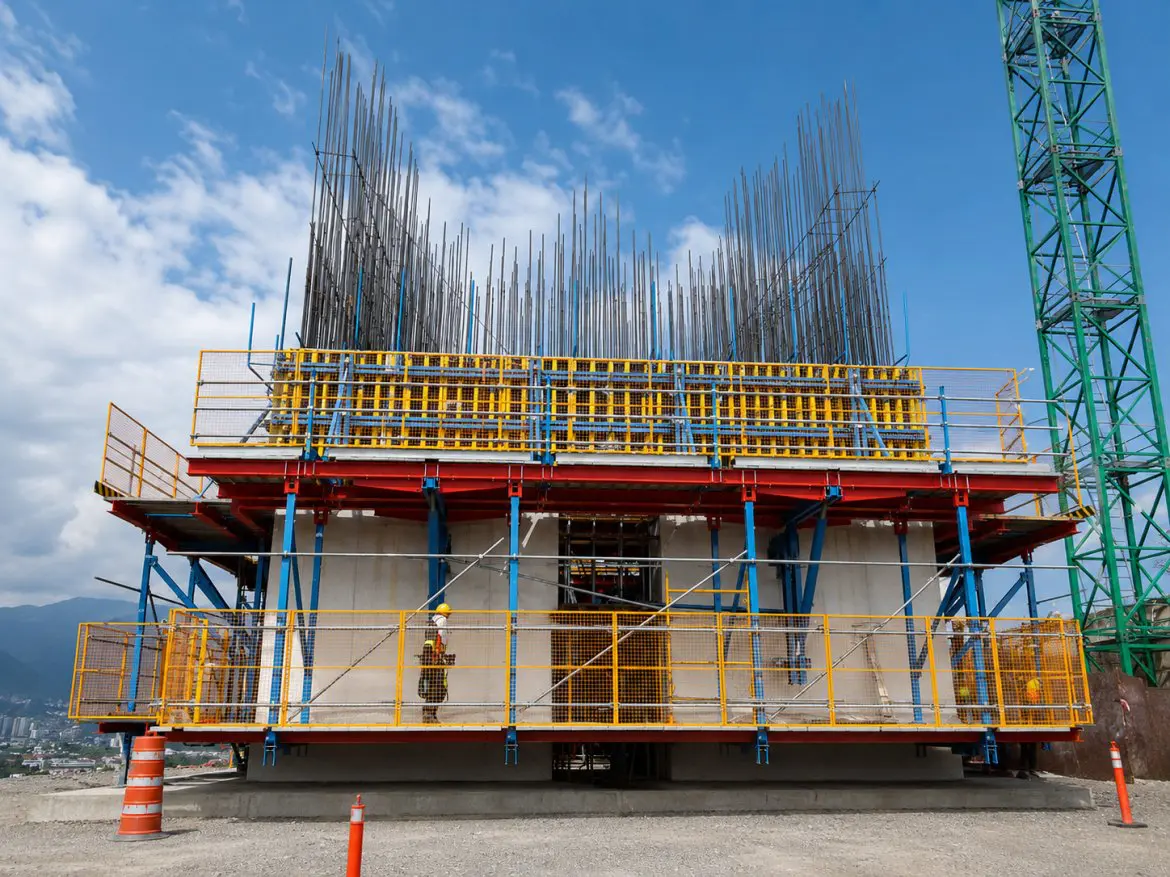
Jumpform, also known as climbing formwork, constructs concrete in separate sections or lifts. The formwork remains in position while reinforcement is installed and concrete is poured. Once the concrete reaches the required strength, the formwork is released and moved upward to the next casting position. The cycle is then repeated.
Depending on the system, jumpform can be crane-climbed, guided, or fully self-climbing.
| Jumpform Type | How It Moves | Key Characteristic |
| Traditional Jumpform | Uses a crane to reposition the formwork. | The crane lifts and moves the forms from one level to the next. |
| Guided Jumpform | Remains connected to the structure while moving. | The guided system provides controlled movement while maintaining connection to the structure. |
| Self-Climbing Jumpform | Uses hydraulic or mechanical climbing equipment to move the system. | Can climb without requiring a crane to lift the complete formwork assembly. |
This staged approach gives construction teams more time between pours. Reinforcement, embedded components, inspections, concrete placement, curing, and formwork adjustments can be organized around a predictable cycle.
What Is Slipform?
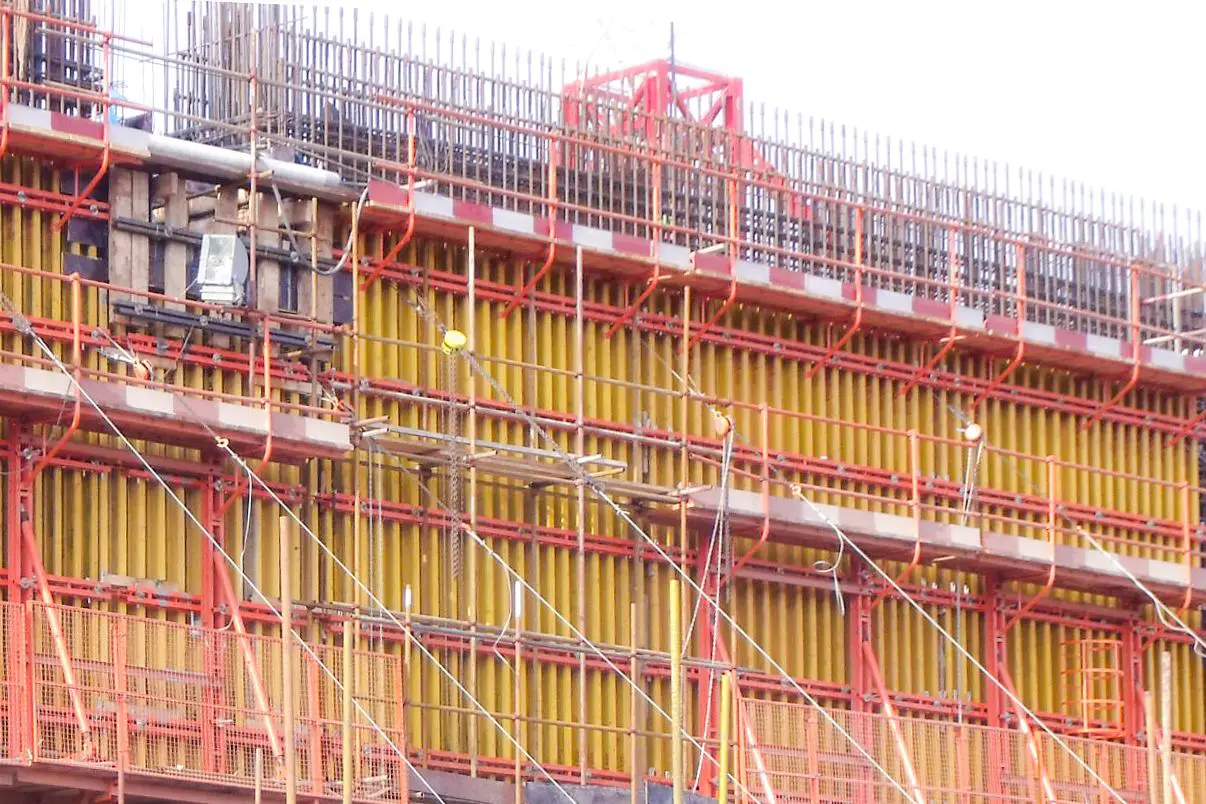
Slipform takes a different approach. Instead of pouring one complete lift and then moving the formwork, the formwork gradually rises while concrete is continuously placed into it.
The formwork typically moves at a controlled rate based on the setting behavior of the concrete. The concrete needs to remain workable where it is being placed while gaining enough strength by the time it leaves the lower edge of the form.
Because the system keeps moving, slipforming can create a continuous concrete structure with few or no conventional horizontal construction joints. It can therefore be a strong option for structures with repetitive geometry and a requirement for rapid vertical progress.
Slipform is commonly associated with structures such as silos, chimneys, bridge piers, towers, and some high-rise cores.
Jumpform vs. Slipform: What Is the Difference?
With jumpform, construction happens in stages. The concrete is poured, allowed to reach the required strength, and then the formwork climbs to the next position.
With slipform, concrete placement and formwork movement happen at the same time. The formwork rises slowly and continuously while new concrete is placed at the top.
This difference affects almost every other aspect of the construction process.
| Factor | Jumpform | Slipform |
| Construction method | Separate concrete lifts | Continuous concrete pour |
| Formwork movement | Moves between lifts | Moves continuously |
| Construction joints | Normally present between lifts | Minimal or none |
| Geometry changes | More adaptable | More difficult |
| Openings and embeds | Easier to accommodate | Require careful planning |
| Concrete supply | More flexible | Must be highly consistent |
| Work schedule | Can be paused between cycles | Normally requires continuous operation |
| Crane dependence | Can be crane-climbed or self-climbing | Usually self-climbing |
| Typical applications | High-rise cores, shafts, complex walls | Silos, chimneys, towers, repetitive cores |
| Main advantage | Flexibility and control | Speed and continuity |
Self-Climbing Jumpform vs. Traditional Jumpform
Not every jumpform system is automatically self-climbing.
Traditional jumpform may require a crane to lift the formwork from one level to the next. Guided systems can remain connected to the structure while the crane performs the lifting operation. Self-climbing systems, on the other hand, use hydraulic or mechanical climbing mechanisms to move the formwork vertically.
For a tall tower, reducing crane dependency can make a noticeable difference. The crane can be used for other construction activities instead of waiting for the formwork cycle.
Self-climbing systems can also move the working platforms, screens, and related equipment together with the formwork, creating a more consistent work environment as the building rises.
Which System Is Better for High-Rise Core Construction?
If the core has a highly repetitive layout and the project can maintain a reliable supply of concrete and a continuous workforce, slipform may offer excellent productivity.
If the core contains changing wall thicknesses, openings, shaft configurations, embedded elements, or other details that vary between levels, jumpform is usually easier to adapt. jumpform can be a suitable choice.
Site conditions also matter.
A congested urban project may not have reliable access for continuous concrete deliveries. In that situation, the flexibility of jumpform can be attractive. On the other hand, a project with a well-organized batching plant, repetitive geometry, and a tight vertical construction schedule may benefit from slipform’s continuous operation.
How to Choose the Right Formwork System
Before selecting jumpform, slipform, or another self-climbing solution, consider these questions:
| Key Question | Consideration | Impact on Formwork Selection |
| How Repetitive Is the Structure? | A consistent cross-section favors slipform, while frequent changes generally favor jumpform. | Choose slipform for highly repetitive structures and jumpform when the structure changes frequently. |
| How Reliable Is Concrete Supply? | Slipform requires a steady flow of concrete throughout the active operation. | A reliable, continuous concrete supply is important when using slipform. |
| How Much Flexibility Is Needed? | Openings, wall thicknesses, and core layouts may change between levels. | Jumpform offers more flexibility when frequent adjustments are required. |
| How Important Is Crane Availability? | Self-climbing systems can reduce the need for cranes during formwork movement. | Self-climbing jumpform can be advantageous when crane availability is limited or the crane is needed for other tasks. |
| What Is the Target Construction Cycle? | Slipform provides fast, continuous progress, while jumpform follows a structured lift-by-lift cycle. | Choose based on whether the project prioritizes continuous speed or a controlled floor-by-floor cycle. |
| What Are the Site Conditions? | Urban traffic, storage space, weather, labor availability, and site access can all affect construction. | Select the system that best fits the project’s specific site constraints. |
| How Complex Is the Core? | A simple shaft and a complex multi-function core may require very different formwork strategies. | Simple cores may suit slipform, while complex cores often benefit from the flexibility of jumpform. |
Looking at these factors together gives a much clearer picture than comparing equipment speed alone.
Final Thoughts
Jumpform, slipform, and self-climbing formwork all solve the same basic challenge: how to construct tall concrete structures efficiently as the work moves upward. The difference lies in how they move, how concrete is placed, and how much flexibility the construction team has during the process.
Slipform is built around continuity and speed. Jumpform is built around controlled cycles and adaptability. Self-climbing technology adds another layer of efficiency by allowing the formwork to move with less dependence on cranes.
We make high-rise formwork simpler, faster, and ready to climb with you. Let’s build smarter together with reliable Jumpform, Slipform, and Self-Climbing Formwork solutions!
FAQ
Jumpform is commonly used to describe a type of climbing formwork. The system moves upward in separate stages after each concrete lift reaches the required strength. Self-climbing jumpform uses hydraulic or mechanical equipment to raise the system without relying on a crane for the climb.
Slipform can be faster when the structure has repetitive geometry and the project can maintain continuous concrete placement. However, the actual construction rate depends on concrete setting time, reinforcement work, equipment, weather, site logistics, and the design of the structure.
Yes. One of jumpform’s practical advantages is that the operation is organized into separate lifts. Once a lift is completed and the concrete reaches the required strength, the formwork can be moved during the next stage of the cycle. This gives the construction team more flexibility than a continuous slipform operation.
Not necessarily. Self-climbing formwork generally uses hydraulic or mechanical climbing equipment to raise the system. Traditional crane-climbed formwork still requires a crane, while guided systems may combine climbing anchors with crane lifting.
Slipform is often used for tall structures with repetitive geometry, including silos, chimneys, towers, bridge structures, and certain high-rise cores. Its continuous movement makes it particularly suitable when the cross-section changes little during construction.
Jumpform is commonly used for high-rise building cores, shear walls, lift shafts, stair shafts, and other vertical concrete structures where construction takes place in repeated lifts. It is especially useful when the geometry or embedded elements change between levels.
It depends on the tower design. A highly repetitive core with stable geometry may benefit from slipform, while a residential tower with changing shaft layouts, openings, and service requirements may be better suited to jumpform. Project schedule, concrete supply, crane availability, and local site conditions should also be considered.
Engineer Your Next Climb With TECON
From jumpform to self-climbing systems, TECON supports high-rise concrete cycles.